
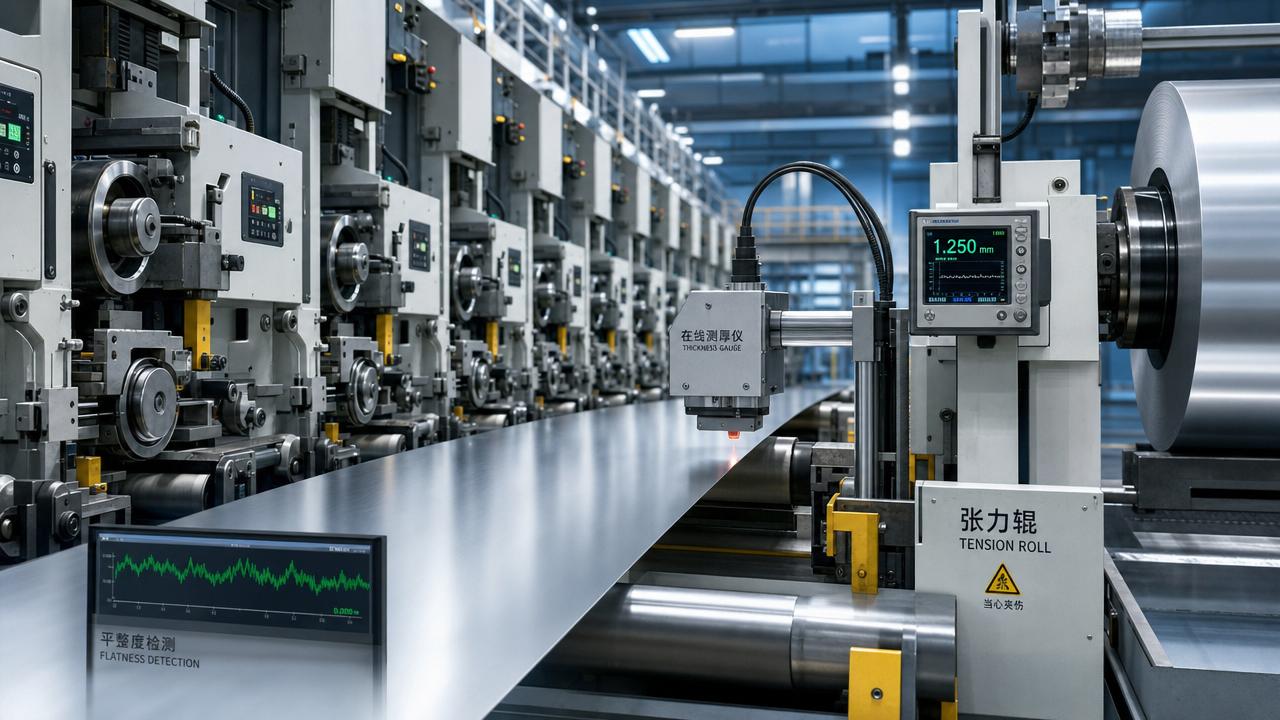
Evaluating a Cold Rolling Line requires more than checking nameplate capacity. Real performance shows up when the line runs different steel grades, changing widths, and long production campaigns without losing output or thickness stability.
For technical assessment work, the key question is simple: can the Cold Rolling Line hold target gauge, speed, and flatness at the same time? That is where many lines look similar on paper but perform very differently on site.
A solid review should connect mill design, automation, strip tracking, maintenance access, and data quality. When these pieces match the process window, output becomes predictable and thickness control becomes easier to sustain.
Start with the real output window, not only rated capacity
The first step is to define what “output” actually means for the Cold Rolling Line. Rated tons per year can hide downtime, speed limits on thin gauges, and reduced throughput on harder steel grades.
Check performance by product mix. A line may reach top speed on wider, medium-gauge coils, but lose efficiency on narrow strips or stainless materials needing stricter tension control.
- Compare guaranteed output against actual coil schedule, not a single benchmark coil. Include width range, entry thickness, final thickness, grade strength, and expected yield loss.
- Review acceleration, deceleration, threading, welding, and coil change time. These “small” intervals often decide whether a Cold Rolling Line meets annual tonnage targets.
- Ask for output curves by gauge and grade. If the supplier only gives maximum speed, the evaluation is incomplete and output risk remains hidden.
- Check whether lubrication, coolant flow, and roll force limits reduce speed during long campaigns. Stable output matters more than short peak performance.
A practical review also separates mechanical speed from usable production speed. If the strip cannot stay stable at that speed, the number has little decision value.
Look closely at thickness control architecture
Thickness control is the heart of any Cold Rolling Line assessment. Good results depend on sensors, actuator response, mill stiffness, hydraulic behavior, and model quality working together.
Start with the gauge control strategy. Confirm how the line handles entry variation, bite disturbances, speed changes, and strip temperature influence during continuous operation.
- Verify gauge meter control, mass flow control, and feedback loops. A capable Cold Rolling Line should switch smoothly between control modes without creating thickness spikes.
- Check X-ray or isotope gauge placement and response time. Poor sensor location can delay correction and increase off-gauge length at head and tail.
- Measure actuator speed for hydraulic gap control and tension regulation. Slow response often shows up first on thin strip and high-speed rolling.
- Ask for thickness tolerance data over full coil length, not average values only. Local instability can be hidden when reports use broad statistical summaries.
One common mistake is accepting tolerance claims without coil-end data. Head and tail sections usually reveal whether the Cold Rolling Line is truly well tuned.
What to confirm in automation and data capture
Automation quality can make an average mill perform well, or make a strong mechanical design underperform. It deserves a separate review, not a quick software checkbox.
- Confirm that process data is recorded at enough frequency to capture transients. Low-resolution logs can hide tension jumps, force oscillation, and gauge drift.
- Review alarm logic and operator guidance. The best Cold Rolling Line control system helps identify root causes before output loss becomes a shift-long problem.
- Check model adaptability for different steel grades. Stainless, low-carbon, and high-strength materials should not rely on one fixed setup philosophy.
Evaluate mill stand design, tension stability, and strip shape together
Thickness control never works alone. If roll bending, stand stiffness, and inter-stand tension are weak, the Cold Rolling Line may chase gauge while creating shape problems.
That is why stand design and strip path stability should be reviewed at the same time. Mechanical limits often define the true process window more than software settings do.
- Check stand stiffness, backup roll support, and bearing design. A stiffer structure usually improves repeatability, especially when rolling harder or thinner material.
- Review roll bending, shifting, and crown control capability. These functions matter when the Cold Rolling Line must keep both thickness and flatness within tight targets.
- Confirm inter-stand tension measurement accuracy and control bandwidth. Unstable tension can trigger thickness variation even when gap control appears normal.
- Inspect threading path and strip support equipment. Poor strip guidance increases the chance of cobbles, scratches, and unstable operation at high speed.
In stainless applications, tension control is even more sensitive. Surface quality and edge condition can deteriorate quickly if the line responds too aggressively.
In related steel processing projects, some operations compare rolling performance with downstream structural needs. For example, matching product consistency with items such as 310S Stainless Steel I-Beam can help verify whether upstream process stability supports broader material quality expectations.
Check utility systems and wear points before trusting long-run stability
A Cold Rolling Line may look excellent during a short acceptance run, then lose stability after several shifts. Utilities and wear behavior usually explain that gap.
- Check coolant contamination control and nozzle condition. Poor spray uniformity can gradually reduce strip quality and make thickness correction less consistent.
- Review roll wear rate and replacement time. A Cold Rolling Line with difficult roll change procedures often loses effective output through maintenance delays.
- Confirm spare parts access for gauges, valves, servo components, and drive modules. Long lead times create hidden operational risk after commissioning.
Use realistic operating scenarios during technical review
Scenario testing gives better insight than brochure claims. It shows how the Cold Rolling Line reacts when conditions move away from the easiest production case.
Scenario: thin gauge at high speed
This is where control response becomes visible fast. Watch tension noise, head-end off-gauge length, strip flutter, and shape correction stability across the full coil.
If the line reaches speed but needs frequent operator intervention, the practical output is lower than the technical specification suggests.
Scenario: mixed grades in one shift
A strong Cold Rolling Line should adapt quickly between soft and hard materials. Setup time, model correction speed, and coil-to-coil repeatability matter more than one ideal recipe.
This is also where operator interface quality becomes obvious. Clear setup recommendations reduce transition losses and lower dependence on individual experience.
Scenario: long continuous campaign
Long runs expose heat buildup, roll wear, sensor drift, and coolant consistency. These factors often explain why a line passes testing but misses monthly output later.
- Request trend data over several coils, not one sample result. Stable control over time is a better indicator than short-term acceptance performance.
- Track off-gauge length, cobble events, surface defects, and unplanned stops together. Output and thickness control should always be judged as one operating system.
Common gaps that distort decision-making
Several issues repeatedly weaken Cold Rolling Line evaluation. They are easy to miss because they sit between departments rather than inside one specification sheet.
- Do not review thickness tolerance without checking sampling method. Different reporting windows can make two lines look similar when their real stability differs greatly.
- Do not separate mechanical design from maintenance access. A line that is hard to service will gradually lose both output and gauge accuracy.
- Do not ignore training and tuning support. Even a capable Cold Rolling Line needs structured parameter optimization after startup.
- Do not assume similar steel products mean similar rolling behavior. Material family, strength, and surface requirement can shift the acceptable control window.
A quick cross-check with adjacent steel applications can also be useful. Products like 310S Stainless Steel I-Beam remind evaluators that upstream dimensional consistency often affects broader downstream quality expectations.
Build the final judgment around measurable proof
The best way to evaluate a Cold Rolling Line is to combine design review with operating evidence. Focus on repeatable output, coil-length thickness control, stable tension, and maintainable equipment.
If a line can hold tolerance during difficult gauges, mixed grades, and extended campaigns, it is far more likely to meet long-term production goals. If it only performs well under ideal conditions, the risk remains high.
For the next step, compare candidate lines using the same product mix, tolerance method, and downtime assumptions. That will give a much clearer basis for decision-making than rated capacity alone.
Get real-time quotes
Interested? Leave your contact details.