
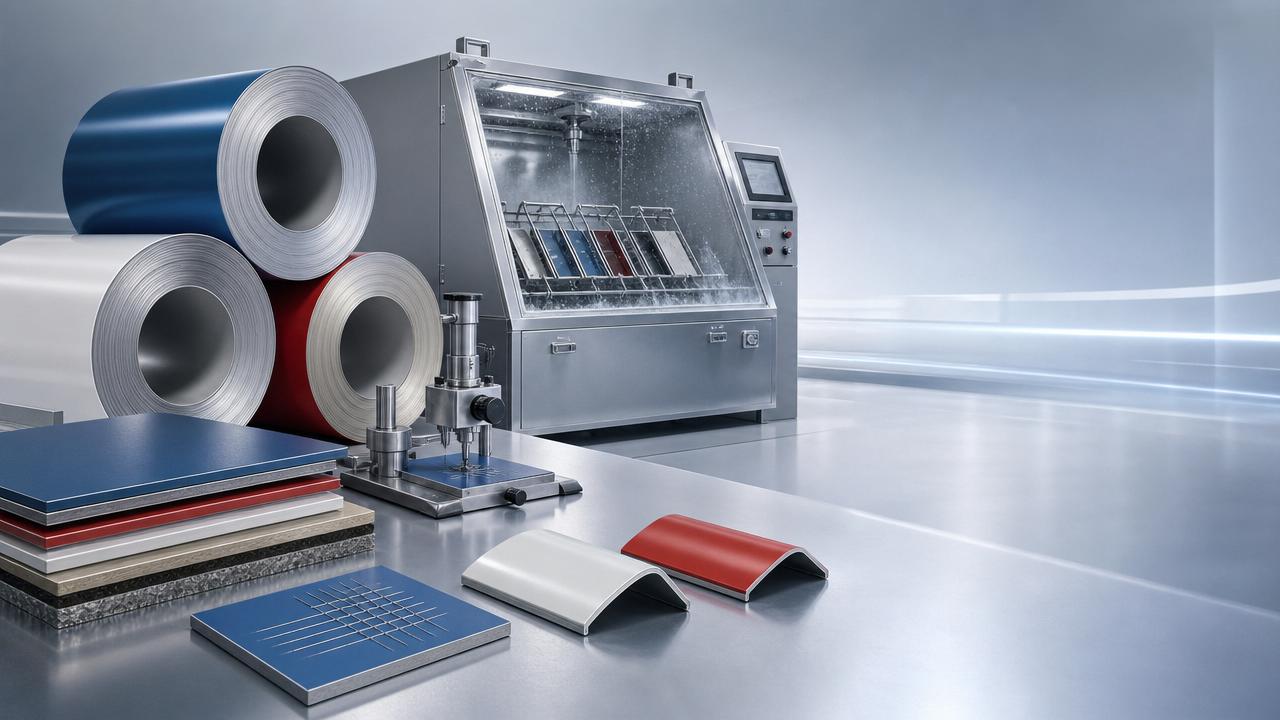
Prepainted Steel standards matter more than many buyers expect
Prepainted Steel is often compared by color, price, and lead time first.
That is understandable, but it misses the factors that control service life.
In construction, appliances, and industrial fabrication, real performance depends on standards and coating tests.
Those documents tell you how the steel substrate behaves, how the paint system is built, and how durability is verified.
A good-looking sheet may still fail early if adhesion, flexibility, or corrosion resistance are weak.
So the practical question is not only what Prepainted Steel is, but which standards prove it is suitable.
What exactly should you check in a Prepainted Steel specification?
A reliable specification usually combines three parts: base metal, metallic coating, and organic paint system.
If one part is vague, comparisons become difficult.
For the steel substrate, common references include ASTM, EN, JIS, or ISO related grades.
These standards define thickness tolerance, mechanical properties, and formability.
For metallic coating, you may see hot-dip galvanized, galvalume, or zinc-aluminum-magnesium systems.
The coating mass, often shown as g/m², is critical for corrosion protection.
Then comes the paint system.
This includes primer type, topcoat type, dry film thickness, gloss range, color tolerance, and back coat.
In actual use, buyers often focus only on topcoat thickness.
A better approach is to read the full stack-up, because primer quality strongly affects adhesion and long-term corrosion control.
- Steel grade and nominal thickness
- Metallic coating type and coating mass
- Primer and topcoat chemistry
- Paint thickness on top and reverse sides
- Surface finish, gloss, and color tolerance
- Referenced test methods and acceptance criteria
Without these details, one Prepainted Steel offer may look equal to another while delivering a very different lifecycle.
Which coating tests usually tell the real story?
Not every test has the same value.
Some are basic production checks, while others are better indicators of field durability.
The most useful set usually mixes appearance, adhesion, forming, and corrosion tests.
Adhesion and forming tests
Cross-hatch adhesion is common because it is quick and easy to compare.
It checks whether the coating remains attached after cuts and tape pull.
T-bend testing is also important for Prepainted Steel used in profiling or deep forming.
A coating that cracks during bending may lead to exposed metal at edges and corners.
Impact resistance gives another clue.
This matters where handling, roll forming, or transport damage is likely.
Corrosion and weathering tests
Salt spray testing is widely requested, though it is often misunderstood.
It is useful for comparing systems under controlled lab conditions.
Still, more hours do not always equal longer outdoor life.
Humidity resistance and cyclic corrosion tests can be more realistic for some environments.
UV weathering tests help estimate chalking, fading, and gloss loss.
For roofing, cladding, and visible appliance panels, these visual aging results matter almost as much as rust resistance.
A single test result rarely gives a full answer.
The more reliable judgment comes from reading several test results together.
Are all standards equally useful for every application?
Not really.
The right standard depends on how the material will be processed and where it will be used.
For indoor appliance panels, color consistency, surface smoothness, and formability may come first.
For roofing and wall systems, corrosion and UV resistance usually move higher on the list.
Industrial enclosures may need a balance of chemical resistance, scratch resistance, and flatness.
This is why test reports should be matched to the end environment, not just collected as paperwork.
In projects where different metals are reviewed side by side, it is also common to compare coated carbon steel with stainless options.
For highly corrosive settings, some teams also review materials like 316/316L Stainless Steel Plate as a benchmark for corrosion expectations.
That does not replace Prepainted Steel, but it can sharpen material selection logic.
How can you compare two Prepainted Steel offers without being misled?
This is where many sourcing decisions go wrong.
Two offers may use similar wording, yet differ in coating weight, paint chemistry, and test thresholds.
A lower price sometimes reflects a thinner metallic layer or a less durable topcoat.
The safer method is to compare line by line.
- Check whether nominal and minimum coating thickness are both declared.
- Confirm the exact paint type, such as polyester, SMP, PVDF, or PU.
- Ask which test method standard was used, not only the result value.
- Review whether the sample was tested on flat sheet or after forming.
- Look for edge corrosion criteria, blistering limits, and gloss retention requirements.
It is also worth checking whether the supplier provides batch traceability.
Consistent Prepainted Steel quality depends on process control, not only on one successful sample.
What are the most common mistakes when reviewing coating tests?
One common mistake is treating salt spray hours as the only sign of quality.
That number is easy to market, but it does not explain everything.
Another mistake is ignoring forming performance.
A panel may pass corrosion tests on a flat sample and still crack after profiling.
Some reviews also skip the reverse side coating.
That matters when condensation, cleaning chemicals, or enclosed moisture are expected.
A quieter but serious issue is mixing standards from different systems without understanding equivalence.
ASTM, EN, ISO, and JIS can often be aligned, but not always directly.
If comparison becomes unclear, ask for the original test method and acceptance range.
In more aggressive environments, teams may even compare lifecycle cost against alternatives like 316/316L Stainless Steel Plate, especially when repainting or failure risk is expensive.
So what is the smartest next step before choosing Prepainted Steel?
Start with the service environment, not the catalog finish.
Ask how much UV, humidity, salt, forming stress, and cleaning exposure the material will face.
Then build a short checklist of must-have standards and tests.
For many projects, that checklist should include substrate grade, metallic coating mass, paint system, adhesion, bend performance, and corrosion testing.
If appearance is important, add color tolerance, gloss retention, and weathering data.
Prepainted Steel performs well when selection is tied to the real use condition.
Problems usually start when materials are chosen from broad claims instead of verified details.
A careful review of standards and coating tests makes comparison clearer, risk lower, and long-term performance easier to predict.
Before moving forward, organize the required properties, compare test methods side by side, and confirm which results truly match the intended application.
Get real-time quotes
Interested? Leave your contact details.